Metalphoto specifications
Metalphoto Certification Standards for UK Buyers: What to Check Before Ordering
Metalphoto is specified across demanding industrial, military and aerospace applications, but a material specification is not the same thing as an automatic guarantee that every finished label meets every requirement.
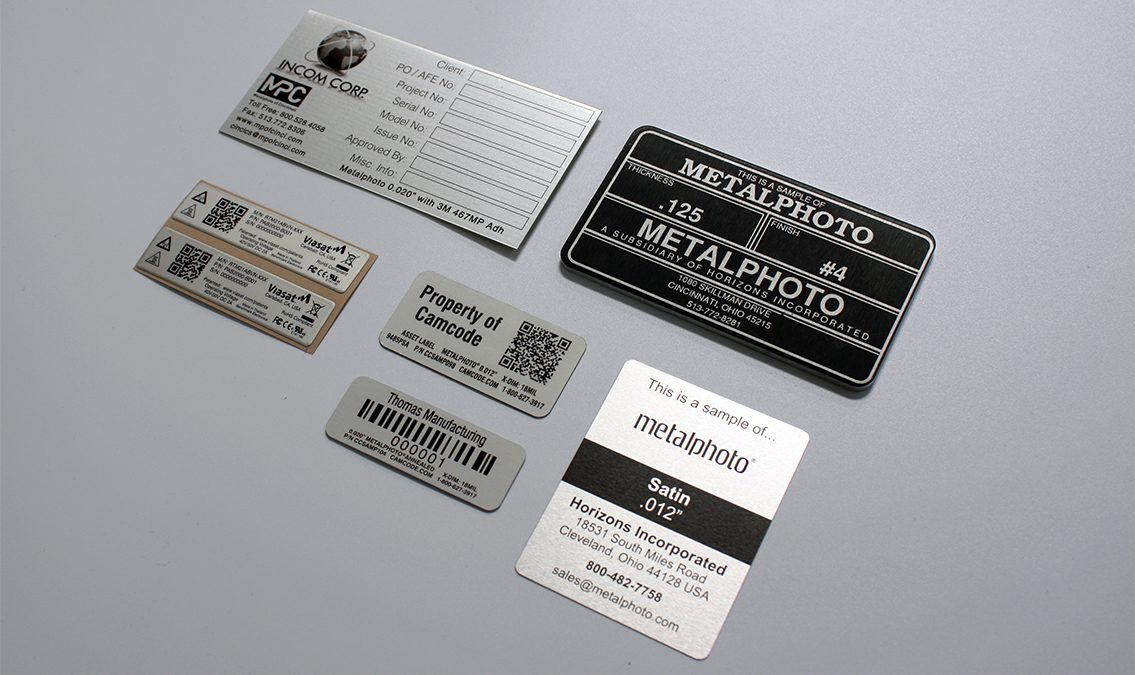
Metalphoto is photosensitive anodised aluminium. The image is formed within the anodic layer rather than printed onto the surface in the usual sense, which is why the material is used where identification has to remain legible through exposure to weather, abrasion, heat, cleaning and chemicals.
The manufacturer publishes performance data, independent evaluations and specification references in the Metalphoto Resource and Trust Center. That is the right place to start when a drawing, purchase order or quality plan calls for a particular material standard.
A specification is not the same as a blanket certification
This distinction matters. Horizons, the manufacturer of Metalphoto, publishes documentation showing that specified Metalphoto materials can be used to meet a range of government and military requirements. The finished identification item still has to match the customer drawing, required material, thickness, finish, attachment method and any other project specific requirements.
For that reason, a buyer should not simply ask whether a label is “certified”. The useful question is which specification and revision applies, what part of that specification concerns the material, and what evidence has to accompany the finished parts.
Check the exact specification designation
A specification may be written as MIL-PRF-8625F, while current Metalphoto manufacturer documentation lists MIL-A-8625F for anodic coatings, including the photosensitised nameplate application. If your drawing uses a different prefix or revision, check the requirement exactly rather than assuming the names are interchangeable.
GG-P-455B is specifically associated with photographic plates and foils made from photosensitive anodised aluminium. It is one of the most directly relevant historic specifications for Metalphoto material.
DMS-1674G also appears in the manufacturer’s current certificate of compliance for defined Metalphoto material classes. Buyers should still state the required class and type on the order or drawing.
MIL-DTL-15024G covers identification of equipment and includes plate and foil types. Metalphoto is referenced by the manufacturer for relevant types, but dimensions, thickness and attachment still need to follow the project requirement.
MIL-DTL-19834C concerns adhesive backed metal foil identification and instruction plates. Where this standard is specified, the foil construction and adhesive requirements matter as much as the image itself.
A-A-50271 is a Department of Defense commercial item description for identification plates. Metalphoto manufacturer documentation references specific compositions and classes rather than every possible configuration.
MIL-P-6906B is associated with identification plates for aircraft instruments, accessories, major structural assemblies and aircraft equipment where photosensitive aluminium plate is specified.
What the material is proven to withstand
Metalphoto manufacturer testing documents resistance to sunlight and weathering, abrasion, salt spray, a wide range of chemicals and solvents, high temperature exposure and low temperature exposure. The important point is not to convert those tests into an unlimited promise. Horizons itself states that it does not warrant material performance in every environment.
That makes application information important. A label exposed to jet fuel, hydraulic fluid, outdoor weather, repeated cleaning, severe heat or heavy abrasion should be specified with those conditions in mind rather than selected only from a generic durability claim.
What to send with an enquiry
- The drawing or artwork, preferably with the applicable specification and revision stated clearly.
- Required material thickness, size, finish and quantity.
- Whether the parts are adhesive backed, mechanically fixed or supplied without attachment.
- Any serialisation, barcodes, data matrix codes or variable information.
- The operating environment, including chemicals, temperature, outdoor exposure and cleaning processes where relevant.
- Any certificate of conformity, material certificate or inspection requirement that has to accompany the order.
Premium Signs supplies Metalphoto anodised aluminium
Premium Signs manufactures Metalphoto labels in anodised aluminium. It should not be assumed that a stainless steel or other metal alternative is part of the same Metalphoto process. Where a controlled specification is involved, the safest route is to provide the drawing and required standard before production so the requested construction can be checked against the available material.
The key point for UK buyers is simple: specify the requirement, not just the brand name. Metalphoto has extensive manufacturer documentation behind it, but the finished label still has to be ordered in the correct form for the application.