Industrial label design
Designing for Durability: A Practical Guide to Industrial Labels
Industrial identification has to do more than look correct on a proof. It has to remain legible, attached and useful in the environment where the equipment actually works.
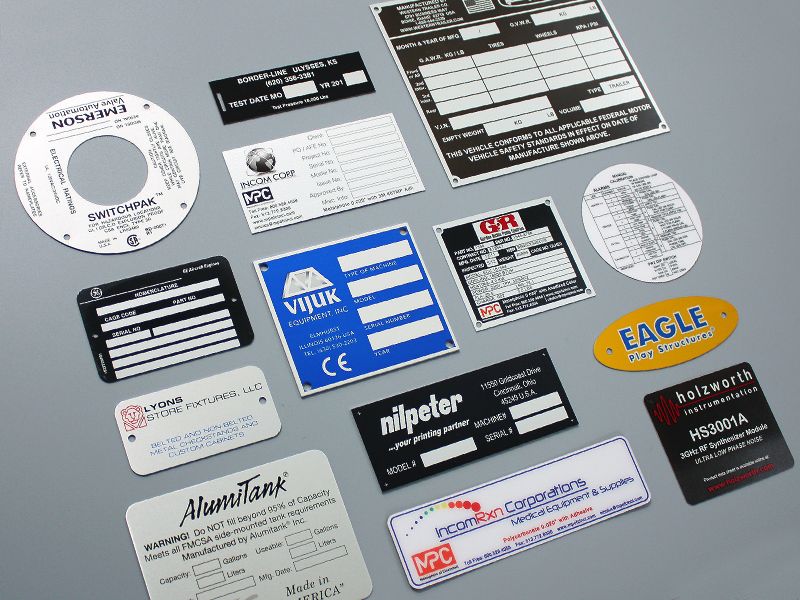
Industrial labels sit at the point where graphic design meets engineering. A successful label has to communicate quickly, fit the available space, survive the operating environment and remain attached for as long as the information is needed.
That is why industrial labels should be designed from the application backwards. Temperature, chemicals, abrasion, weather, cleaning, fixing method and required service life all influence the right construction.
Choose the material for the environment
For demanding permanent identification, Metalphoto metal labels use photosensitive anodised aluminium with the image sealed within the anodic layer. Manufacturer testing documents resistance to weather, abrasion, chemicals, salt spray and temperature, which is why the material is used for equipment nameplates, rating plates, asset identification and control information.
The manufacturer’s Metalphoto design guidance is useful because it treats the substrate, image method and attachment as one identification system rather than separate choices.
Legibility comes before filling the available space
The most common design failure is trying to fit too much information into too little area. Small text, compressed line spacing and weak hierarchy can make a technically accurate plate difficult to use. Start by deciding which information has to be found first, then build the layout around that priority.
- Use a clear hierarchy for equipment name, model, serial number, ratings and warnings.
- Keep text large enough for the expected viewing distance and lighting conditions.
- Use strong contrast and avoid decorative detail that competes with operational information.
- Leave room around fixing holes, edges and cut outs.
- Do not place critical data where it can be obscured by fasteners or surrounding equipment.
Variable data needs its own design rules
Serial numbers, asset numbers, barcodes, QR codes and data matrix codes introduce another layer of risk. The variable field has to remain inside the printable area, keep the required quiet zone and use a data source that can be checked before production.
When a family of industrial labels shares one layout, it is worth testing the longest expected serial number and the most information dense record rather than approving only the shortest example.
The fixing method is part of durability
Adhesive backed labels can be suitable where the substrate and environment allow it. Mechanical fixing can be preferable where vibration, heat, surface contamination or long service life make adhesive performance harder to control. Holes, corner radii and edge distances should therefore be designed into the plate from the beginning.
Specify aluminium correctly
Premium Signs supplies Metalphoto aluminium labels. Metalphoto is an anodised aluminium process, not a stainless steel version of the same product. If a drawing calls for stainless steel, engraved metal, etched metal or another construction, that should be treated as a different manufacturing route rather than described as Metalphoto.
A useful production file contains more than artwork
For repeatable industrial production, the artwork should be accompanied by the dimensions, material thickness, finish, fixing method, hole positions, quantity, variable data rules and any applicable drawing or specification. A visual PDF can show appearance, but it should not be expected to carry every engineering requirement by implication.
The best industrial label is rarely the one with the most design on it. It is the one that remains clear, correct and readable after years of doing an unglamorous but essential job.