Legacy article
The Great German Net Zero Meltdown
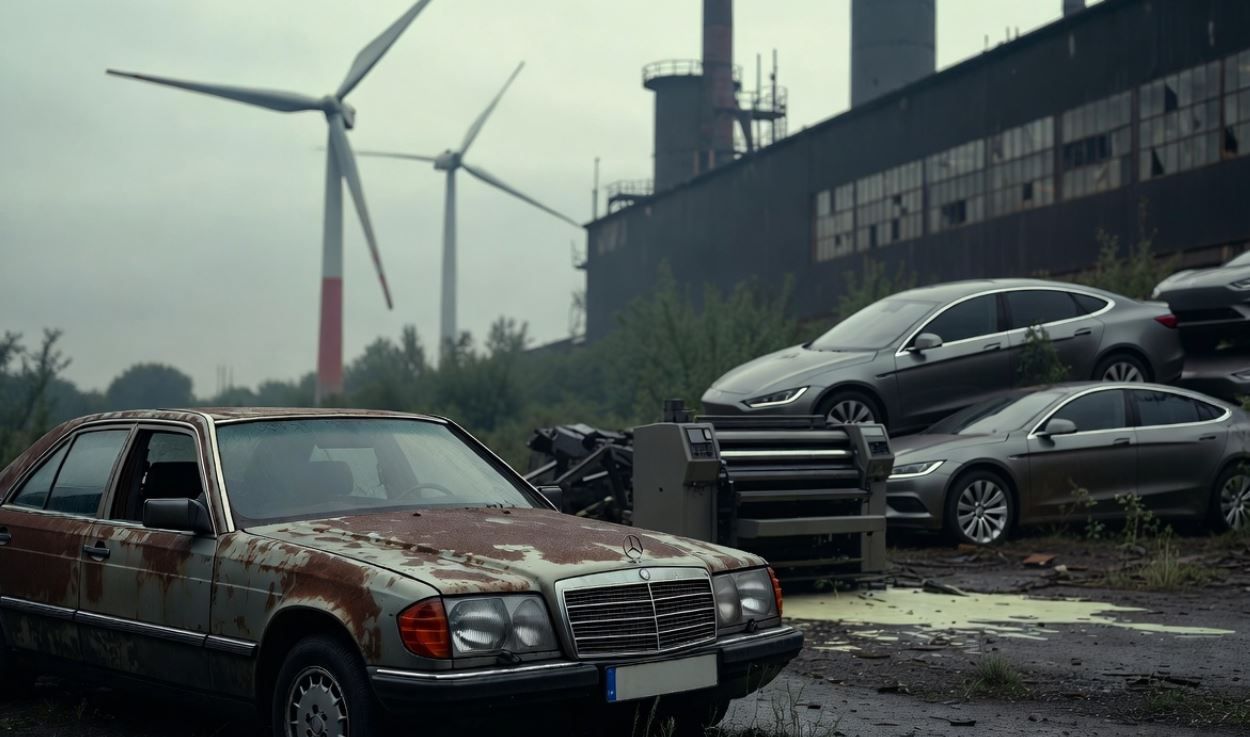
How the Land of Precision Engineering Accidentally Discovered That You Can’t Forge a Wind Turbine Out of Good Intentions and Recycled Marketing Brochures
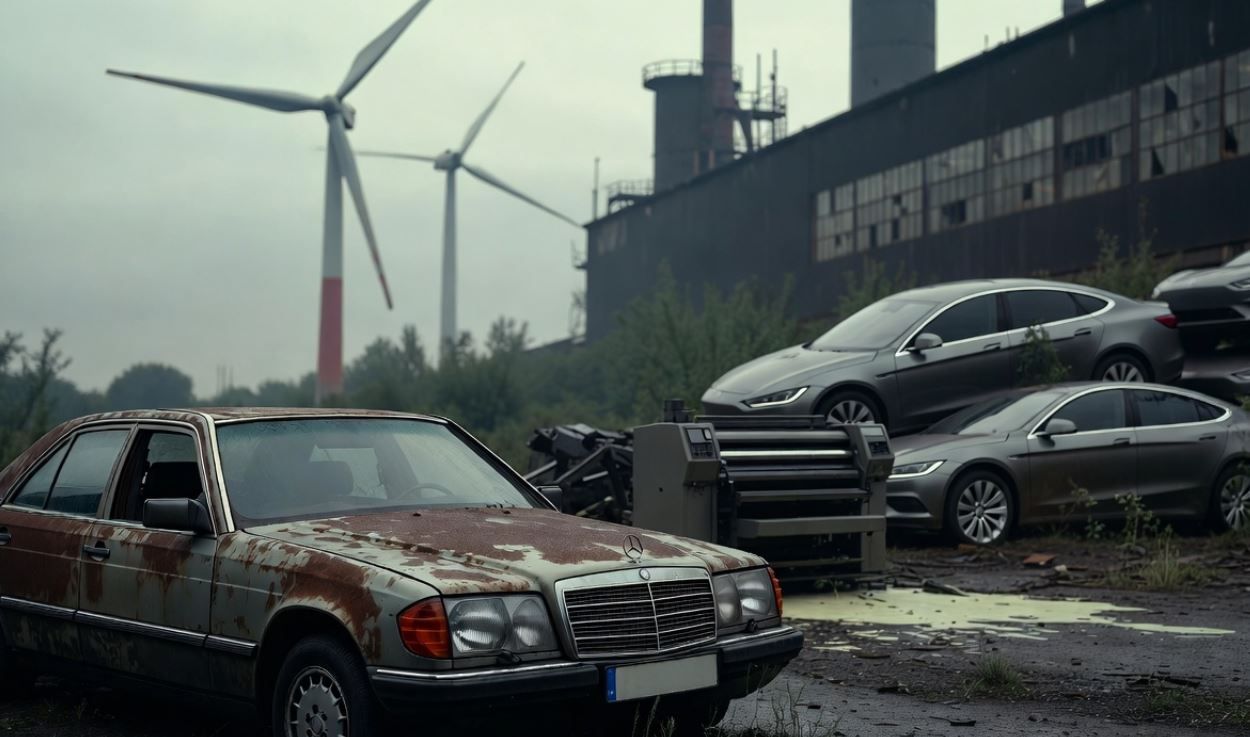
For centuries, German engineering was synonymous with overbuilt, bulletproof perfection.
A Mercedes didn’t just transport you; it did so while silently judging lesser automobiles. A Trumpf laser cutter could slice 3 mm stainless steel (metal) with the casual arrogance of a Michelin starred chef julienning a carrot. And every piece of German machinery came with a 180 page manual printed on 120 g/m² paper that somehow felt heavier than the machine itself. This was the era when “Made in Germany” was less a label and more a threat.
Then came Net Zero, the shimmering global mirage that promised salvation if only everyone would stop using natural gas and start using… hopes, dreams, and an alarming quantity of cobalt mined by children in the Congo. Germany, ever the teacher’s pet of international virtue, sprinted toward the horizon faster than France sprinting away from a labor reform.
Phase 1: The Metallurgical Suicide Pact
German steelmakers (Thyssenkrupp, Salzgitter, Georgsmarienhütte) were politely informed that their blast furnaces, which had been happily eating Ruhr coal since Bismarck, were now “problematic.” The replacement? Green steel produced with hydrogen generated by wind turbines that… didn’t exist yet. In 2022, Germany proudly commissioned the world’s first “green steel” pilot. Output: 100 tons . Annual German steel demand: 35 million tons. You do the math ; even the marketing department gave up after the seventeenth decimal place.
Meanwhile, Chinese steel, produced with glorious, unapologetic coal, flooded the market at 30–40 % lower cost. German fabricators suddenly discovered that “sustainability premium” is corporate speak for “we’re charging you double to go bankrupt slower.”
Phase 2: Manufacturing Discovers the Joy of Rolling Blackouts
Nothing says precision manufacturing like a 5-axis CNC machine that stops mid-cut because the local wind farm is having an existential crisis. In 2023, German industry experienced more unplanned downtime from grid instability than from labor strikes, an achievement previously thought impossible. Trumpf, DMG Mori, and Hermle quietly began shipping machines with optional “Dunkelflaute Package”: a diesel generator tastefully hidden behind an acoustic enclosure that looks exactly like Angela Merkel’s disappointed in you.
Phase 3: Branding Enters Its Delusional Era
German marketing departments, long accustomed to selling $200,000 sedans with the gravitational pull of a small moon, pivoted to selling $600,000 electric sedans with the range of a depressed hamster. The new brand vocabulary included gems such as:
- “Purpose built CO₂ backpack” (translation: 800 kg battery)
- “Progressive luxury silence” (translation: no one can afford to drive it)
- “Engineered like no other battery in the world” (correct, because no sane engineer would have approved it )
VW’s brilliant 2024 campaign for the ID.7 featured the slogan “Born from German engineering. Raised on renewable guilt.”
Phase 4: Printing Becomes Performance Art
The final surrender came from the printing industry, the last bastion of German anal-retentive perfection. Heidelberg, once the Rolls Royce of offset presses, announced in 2025 that its new flagship Speedmaster XL 106 would ship with “carbon neutral ink” made from algae and broken dreams. The ink, it turns out, dries only when the ambient humidity is between 47.3 % and 47.8 %, the press is facing magnetic north, and the operator has achieved inner peace. Printers across Baden-Württemberg were last seen burning pallets of the stuff to stay warm during yet another grid emergency.
Manroland filed for insolvency after its “Sheetfed 9000 Climate Edition” refused to print on anything except paper certified by three separate blockchain verified reforestation projects in Borneo. The machine’s AI proudly announced, “I cannot in good conscience print your brochure until you reduce your personal carbon footprint by 0.7 tonnes.” The brochure was for a wind turbine manufacturer.
Epilogue
In late 2025, the Fraunhofer Institute released a 400 page study concluding that Germany’s manufacturing sector had successfully reduced its CO₂ emissions by 94 %—primarily by ceasing to exist. The remaining 6 % came from the ceremonial burning of the last remaining Siemens gas turbine in a ritual sacrifice to appease Brussels.
The final irony? The world’s new precision engineering capital is now Shenzhen, where factories run 24/7 on coal power so reliable it makes 1980s West Germany look flaky, and where a $60,000 CNC machine ships in six weeks instead of never.
Germany is no longer the engineering capital of the world.
It is now the world capital of beautifully designed, triple-certified, blockchain-verified bankruptcy.